From body of work to knowledge environment
Your work deserves living structure.
Connectome Studio turns publications, projects, archives, ideas, and media into a connected knowledge graph—and a website people and agents can explore.
Two views, one conviction
Choose your lens.
For people and organisations with substantial collections
Your work is more than a list of files.
Books, papers, artworks, projects, posts, objects, and teaching materials often live in separate systems. Connectome Studio helps shape them into a navigable knowledge environment without erasing the relationships that give them meaning.
- Connect material from multiple sources
- Make relationships and provenance explicit
- Publish for human discovery and agentic access
The product
From existing material to connected knowledge.
Connectome Studio brings ingestion, structure, relationships, and publishing into one governed workflow. A website is one public surface of the evolving knowledge system—not the limit of the product.
- 01
Bring in a body of work
Begin with a résumé, publication list, archive, website, document collection, or connected source. The first individual onboarding path turns a résumé into the foundation of a personal knowledge site.
- 02
Find and govern the structure
AI can propose entities, themes, and relationships. People review what the connections mean, correct the vocabulary, and decide what becomes canonical.
- 03
Publish a knowledge experience
Create a personal website, collection explorer, institutional microsite, or other public projection from the same governed graph.
Questions it can help answer
Start with something you need to understand.
Connectome Studio begins with a concrete knowledge problem—not a demographic. These are the kinds of questions a connected body of material can answer.
People and bodies of work
“We need to map out what we know about this person.”
Connect a résumé, publications, projects, appearances, collaborators, interests, and public activity into one reviewable picture.
“We need to show how these ideas and works relate.”
Place writing, research, artworks, influences, evidence, methods, and recurring themes in context rather than in separate lists.
“We need to bring years of scattered output into one owned system.”
Connect websites, social posts, essays, newsletters, video, notes, and projects while preserving their sources and original context.
Collections and systems
“We need to understand what is in this collection.”
Catalogue objects, photographs, records, makers, places, dates, and themes without losing provenance or curatorial interpretation.
“We need to trace the relationships across these events and contributors.”
Reveal how people, works, venues, organisations, programmes, and locations form a wider cultural or institutional ecology.
“We need to understand how these technical systems fit together.”
Map repositories, services, packages, data stores, interfaces, dependencies, and decisions before extending or replacing a system.
POC 01 · Live
A career becomes a living system.
Reza’s work crosses creative technology, product leadership, organisational change, consulting, and live performance. A conventional portfolio could list those chapters. The Connectome shows how they continue to inform one another.
Visit rezarosli.com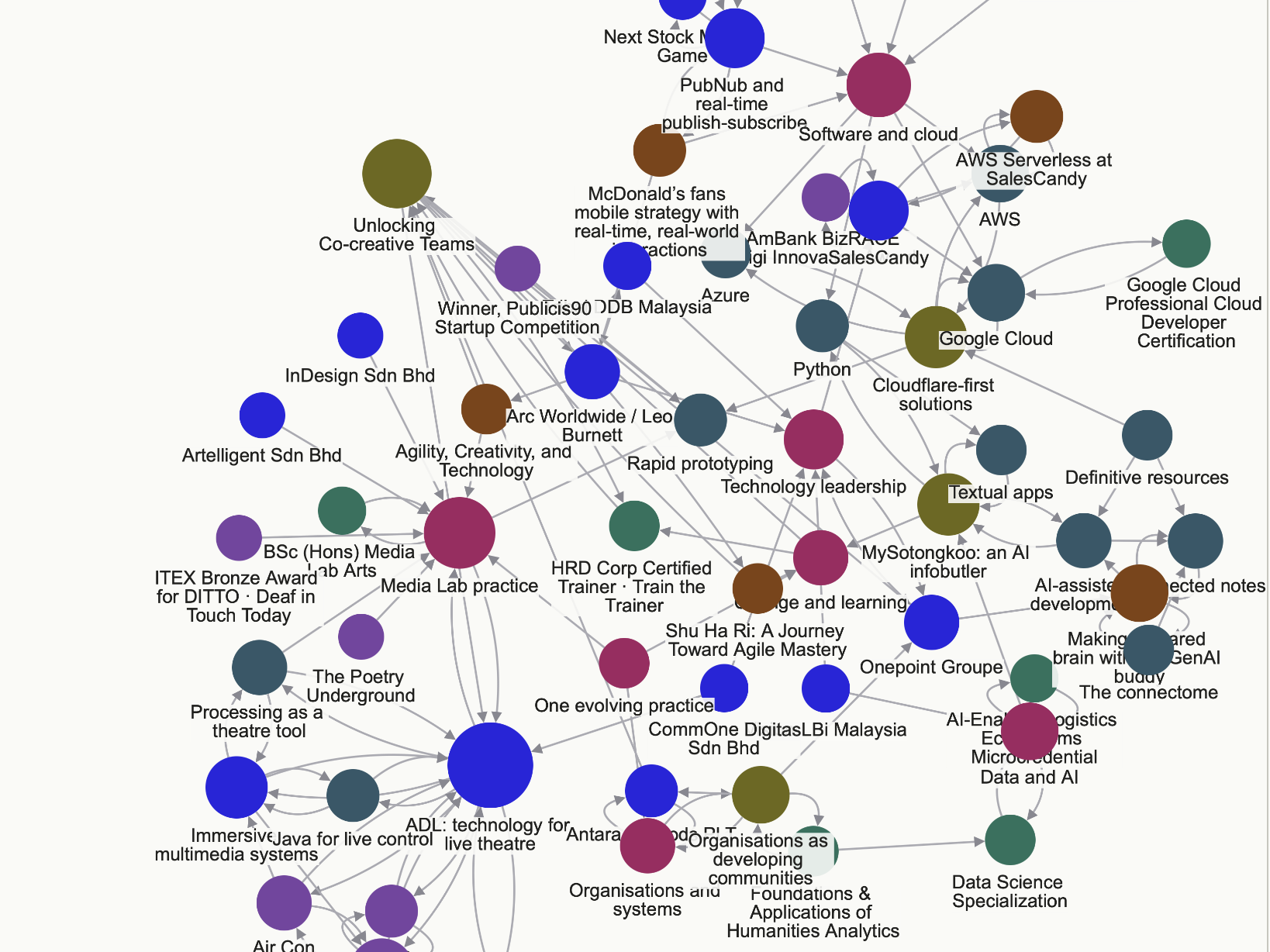
Live knowledge graph
A public map makes the relationships between experience, current inquiry, projects, and published ideas explorable—not merely implied.
One identity, many threads
The site holds technology leadership, ways-of-working coaching, augmenting intelligence, and applied innovation in one coherent practice.
Now sits beside then
A rolling agenda places current questions and experiments alongside more than 25 years of experience, making growth visible without flattening it into a timeline.
Every page can lead somewhere
Cards and notes connect capabilities, organisations, experiments, and reflections so visitors can follow the thread most relevant to them.
What this demonstrates
A résumé can become the first map of a much richer body of work—then grow beyond biography into connected knowledge.
Explore the live ConnectomeProofs of concept
Five bodies of work. Five different graph questions.
The live rezarosli.com prototype anchors four anonymous studies in progress. Together they test how much of the Connectome model can transfer across personal, cultural, curatorial, and technical knowledge.
View the proof-of-concept programme
POC 01 · Live
rezarosli.com
Can a résumé become the first map of a richer body of work, then grow into connected knowledge?
Personal knowledge site POC 02 · In progressA museum-visit photo catalogue
Can personal photographs become a navigable record of objects, institutions, visits, places, and recurring interests?
Collection graph POC 03 · In progressA connected body of work
Can publications, projects, appearances, collaborations, and other activities become a clearer map of a person’s work?
Personal knowledge site POC 04 · In progressAn opinionated Southeast Asian art lens
Can event and artist data support a curated, situated view of a regional art ecology rather than a neutral directory?
Curatorial microsite POC 05 · In progressA map of a legacy software system
Can interconnected repositories reveal architectural patterns and constraints that inform a new commercial system?
Technical knowledge graphTechnical thesis
The next website is readable in two directions.
People need a clear, expressive experience. Agents need stable content, explicit meaning, and inspectable relationships. Connectome Studio treats both as projections of the same human-governed source.
01 · Workflow
Explore the technical approach
Why this architecture fits
File-backed knowledge, proposals, revision checks, private audit, preview, and explicit publication.
02 · AI capabilityBuilding semantic structure
How models can parse content, propose entities and relationships, and help shape machine-readable meaning.
03 · Future webFrom responsive to agent-legible
A website that remains humane to manage while becoming easier for agents to inspect and navigate.
Why now
The web made publishing easy. It never made coherence easy.
People and institutions hold more digital material than ever, yet most collections still appear as lists, folders, feeds, or isolated pages. Valuable context disappears between systems.
Connectome Studio makes the connections publishable.
TodayScattered material
Documents, catalogues, feeds, media, forgotten context
With ConnectomeConnected knowledge
Entities, relationships, provenance, pathways, ownership
The long view
“The most valuable website is not a container of pages. It is a map of meaning.”
Knowledge compounds
A collection gains value when each new item strengthens the context around what already exists.
Stewardship matters
Durable, governed source gives people and institutions independence from platforms, formats, and changing algorithms.
Structure is expression
Relationships between works and ideas become a medium for discovery, interpretation, teaching, and trust.
Connectome Studio · Exploratory stage
Reveal the knowledge inside your body of work.
We’re shaping the first version with people and partners who care about the structure, provenance, ownership, and future usefulness of their collections.
Start a conversation