Proofs of concept · Live experiment
Vredeburg Historical Atlas
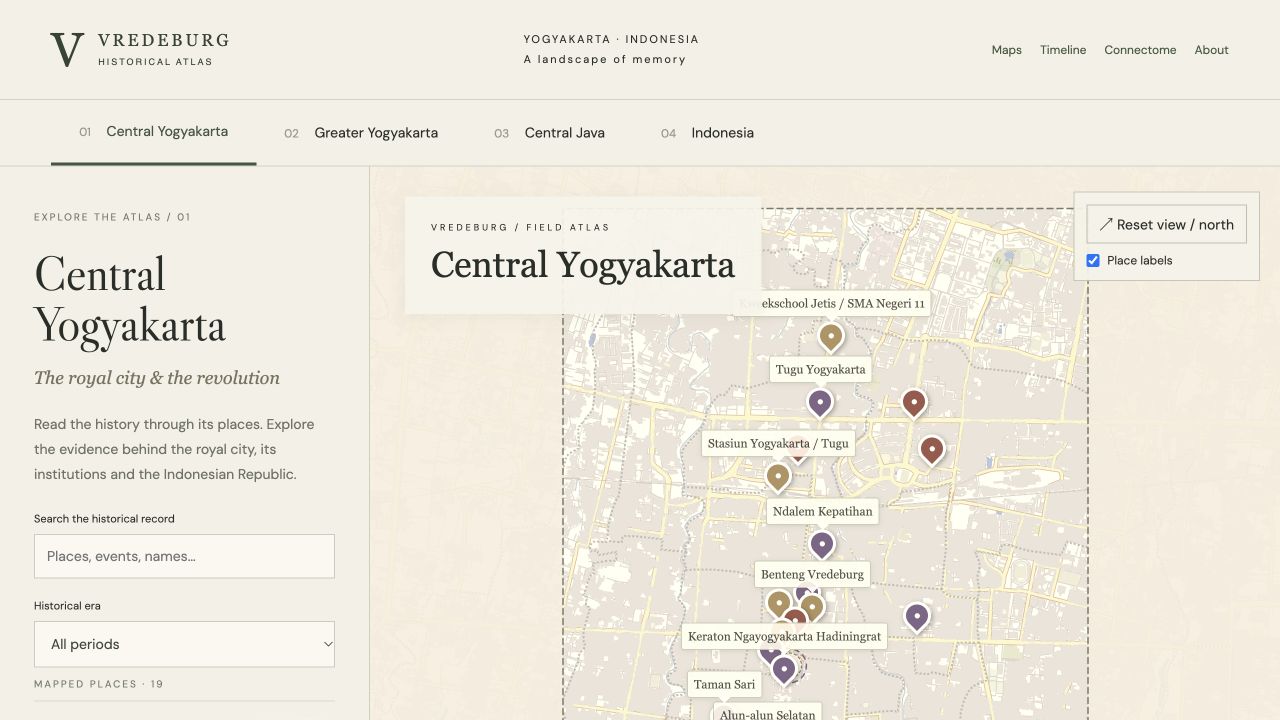
An atlas of Yogyakarta that lets readers start with a place and follow its history through events, people, and sources.
Explore the live site
From a museum guidebook to a city
Fort Vredeburg is the starting point for a project by Reza Rosli about Yogyakarta’s royal, colonial, and Republican history. The museum guidebook provides a documentary foundation. Heritage records, court histories, and archival sources extend the story beyond the fort. The editorial question was how to let readers move from a single site to the wider history around it while keeping the evidence within reach.
How the atlas uses Connectome
Places, events, people, and sources are authored as individual cards with stable addresses. Each relationship has a direction, a type, and a written reason. The same collection feeds the public map, chronology, graph, and reading pages, so readers can approach a record through geography, time, or its connections.
- The map places landmarks in context, from central Yogyakarta to the Indonesian archipelago. It uses modern geography to locate historical records.
- The timeline puts events in sequence and retains the precision supplied by the sources.
- The Connectome graph lets readers choose a place, person, event, or source and inspect the relationships around it. Selecting a connection reveals why the records are linked.
- Sources for the draft
- Gedung Agung place card · Provincial KNI office event record · Yogyakarta heritage register · Indonesian State Secretariat
Your request
Write a short place-card introduction for someone who has just found Gedung Agung on the atlas map. Start with a nearby landmark and explain how the building’s role changed in the first months of Indonesian independence. Attribute dates where the sources differ.
Example draft
Across from Fort Vredeburg, Gedung Agung once housed Yogyakarta’s Dutch governors. The regional heritage register records the local Indonesian National Committee using the building as its office on 29 October 1945. When the Republican government moved to Yogyakarta in January 1946, the building became President Sukarno’s residence. On 7 January, members of the same committee welcomed Sukarno and Vice President Mohammad Hatta in the palace’s central hall.
Editorial check. The State Secretariat places the committee in the building from 5 October. Keep 29 October attributed to the heritage register and flag the office’s opening date for review.
How an AI agent builds the Gedung Agung story
This walkthrough shows how an AI agent could use the atlas’s published graph to answer a visitor’s question. It starts with one place, selects the events that answer the question, and follows their source links before drafting.
-
Find the place
Place Gedung AgungThe place card identifies the building and supplies its colonial context.
-
Read the linked events
Event · Provincial KNI office Event · 1946–1949 Republican government centreThe place lists these under Associated events. Both event cards link back to it as Took place at.
-
Check the evidence
Source Heritage referenceBoth events cite the same Yogyakarta heritage register entry. The agent can check the dated claims there.
A story drafted from the records
Gedung Agung’s change in purpose traces the early years of the Indonesian Republic. On 29 October 1945, according to Yogyakarta’s heritage register, the former colonial residence was serving as the provincial Indonesian National Committee’s office. The palace went on to serve the Republican government during Yogyakarta’s years as capital, from 1946 to 1949.
Committee office record · Government centre record · Heritage register
For editorial review, keep 29 October attributed to the register as a date of documented use.
Inspect a graph link
To find events at Gedung Agung, an agent can look for links of type place whose target is the building’s ID. This link points from the 1945 event to the place.
{
  "source": "event-gedung-agung-0",
  "target": "place-gedung-agung",
  "type": "place",
  "category": "Took place at",
  "reason": "This event forms part of the place’s documented history."
}What the experiment shows
A cultural collection can support several public experiences from the same editorial work. Each view answers a different question about where something happened, when it happened, or how it relates to another record. An exhibition microsite could use the same approach to connect objects, venues, and events while giving each record a page readers can return to.
Read about the atlas and its sources · See the asset credits